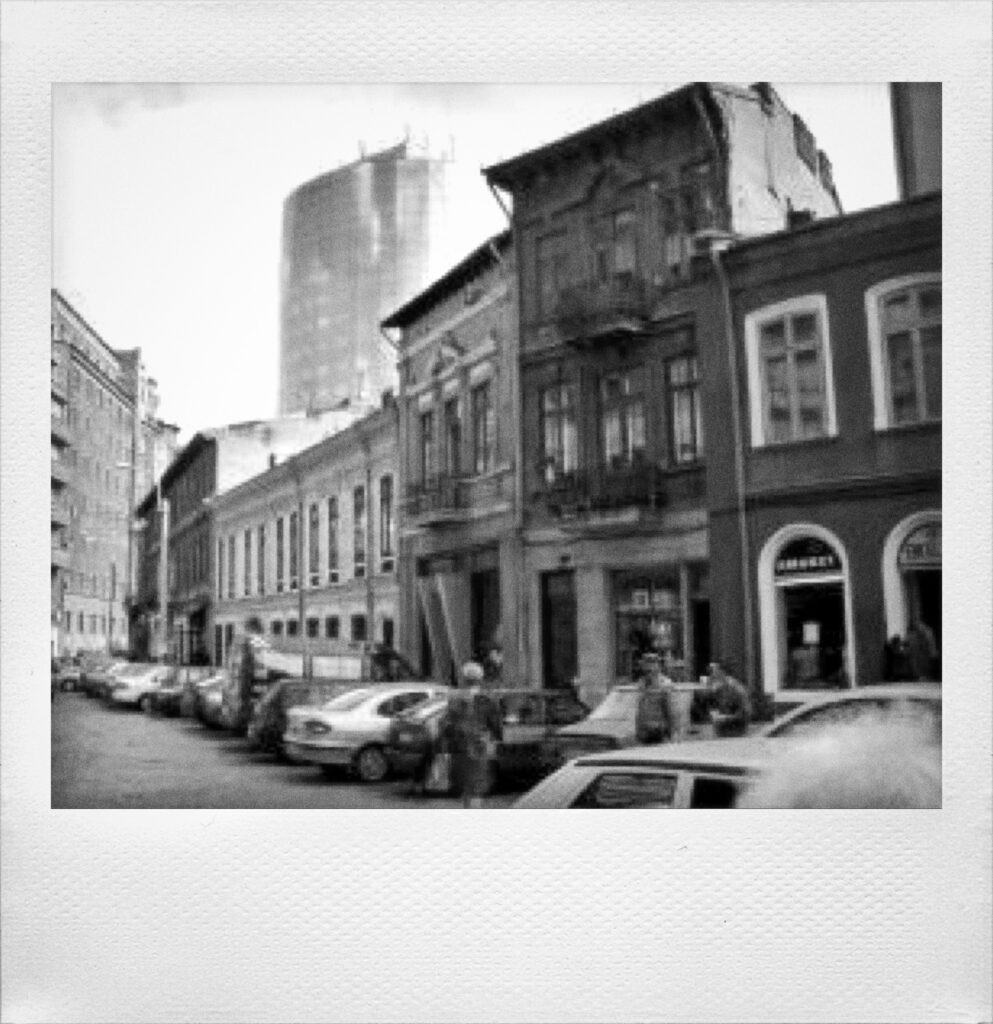
Petru, Puka, and the Sing Sing Express

Bukarest, Gara du Nord area

Bucharest, Romania – March 1992. Halfway through a tiring train journey across Europe, a stop in Bucharest becomes an unexpected encounter with recent history, with a Romanian with ‘a little problem,’ and with ‘she’s really quite crazy’ Puka. 

1. The Border

The Bucharest station lies frozen solid. Waiting trains – cold and uncomfortable – are lined up in Spartan formation on the March morning; their noses aligned to the west. Grubby, unshaven men loiter on the platforms. “Need a room mister? Chance money mister?”

They mumble and speak casually in passing, while looking around suspiciously. As if the Securitate, the secret police, still watches everyone. Drunk invalids on crutches drag themselves along. They are as grey as the dilapidated station and stand out sharply against uniformed groups of officers who – in various shades of vigilant blue – occasionally appear in the station.

I had left the Netherlands two days earlier and transferred in Cologne to the fast Danube Courier via Vienna to Budapest. The international allure faded away in the Hungarian capital. The journey continued with an anonymous train carriage to Bucharest, Romania. Four border crossings after leaving the Netherlands, and many hours later, I wearily hoisted my 25-kilogram heavy backpack at Gara de Nord station and left the train. I was on my way to Varna on the Bulgarian Black Sea coast for a series of articles. Bucharest was meant to be a stop; a short layover like Cologne, Vienna, and Budapest.

But the last part of the journey to Romania was disappointing. In Lőkösháza, the Hungarian railway station at the border with Romania, the train was swarmed by an overpowering presence of customs, militia, and military personnel. Romanian citizens were brutally and rudely removed from the train. Some passengers were led off to a wooden barrack alongside the rails and left there. Soldiers came in and out, rifles slung over their backs.

The snow along the rails was dirty from the many footprints of shunters and soldiers. Outside, it was freezing at around ten degrees. Up to this point, at the border, I had shared the unheated, icy compartment with a thin boy of about twenty. He had stumbled into the compartment in Budapest with two full large plastic bags, an old-fashioned black-checkered suitcase, and an empty look in his eyes. “Shop wisely, Woolworth’s” proclaimed one of the plastic bags. Conversation didn’t flow. The boy was only interested in the contents of his bags, which were checked and almost caressed regularly. He hurriedly emptied a bag of nuts.

In Lőkösháza, he was taken off the train, and I lost sight of him.

‘Sarajevo is very far away’

Varna
Varna, early 1990’s

Varna, Bulgaria, winter and summer 1992 – From shutdown nuclear power plants and candlelit vodka to Baba Marta and the US Navy, sailing to pasta on a driveway and singing fishermen as the sun sets.

1. Mare Incognitum

“How many miles are between Varna and Sarajevo? Can you hear the bombs over there?”

Chairman Hristo Tzetvkov of the local water sports club looks a bit disheartened. In the clubhouse of the marina in Varna, Bulgaria, he repeats the question from a foreign yacht owner. Earlier this year, this owner wanted to know if ’the Black Sea was actually safe’. Hristo shrugs again, discouraged by so much lack of understanding.

A few sailors agree with him. “You know what it is?” says Vladimir Troitsky, skipper of the Russian yacht Hermes and currently a guest in the Bulgarian port city, “Black Sea sounds negative, dangerous. People have no idea what can be found here. For Western Europeans, the Black Sea is Mare Incognitum.”

It’s mid-June 1992. The beginning of this last decade, like the end of the previous one, has been tumultuous in Europe. In November 1989, the Berlin Wall opened. And last year, the Soviet Union dissolved into fifteen separate republics. Almost seventy years after the formation of the USSR, these states have to navigate the slippery path of democracy and capitalism. Or stubbornly cling to the red flag and state control. Or search for something in between.

The same applies to former members of the Warsaw Pact; countries like East Germany, Romania, Bulgaria, and Yugoslavia. The latter is a particularly sad case. After the death of Tito in 1980, the country had already disintegrated into different constituent republics. Ethnic conflicts and rising nationalism in various regions in the following years paved the way for civil war and genocide.

Two months ago, over 700 kilometres away, about thirteen hours by car, the siege of the Bosnian capital Sarajevo began. The Bosnian Serb forces under President Radovan Karadžić had surrounded the city. The other two ethnic groups in Bosnia, the Bosnian Croats and the Bosniaks, had, in the majority, voted in favour of secession from the Federal Republic of Yugoslavia and the establishment of an independent Bosnia and Herzegovina in a February referendum.

In response, the Bosnian Serbs boycotted the referendum and established their own Republic of Srpska, under Karadžić’s leadership. What follows will go down in history as the Bosnian War. A few days after the outcome of the referendum is approved, the Bosnian Serbs besiege Sarajevo. This siege will last nearly four years and cost over 12,000 civilian lives in Sarajevo alone. In total, about 140,000 people will lose their lives during the Yugoslav Wars.

It’s all far from Varna, on the Black Sea. At the beginning of summer, the port city basks in relative tranquility. After Sofia and Plovdiv, it is the third-largest city in the country with over three hundred thousand inhabitants and (after Burgas) the second-largest port in Bulgaria.

It’s my second visit this year, curious about a country that had been virtually sealed off for most Westerners for decades. The previous visit was a few months ago and still fresh in memory. It was the end of winter, bitterly cold, and mostly dark.

“You really need to come back. But this time in summer”, everyone said.